
National Parks & Sanctuaries
2
National Parks
4
Sanctuaries
361.58
Area (Sq Km)
1000
Species Protected
 National Park
Balpakram National Park
Steeped in Garo tribal legend as the sacred "Land of Departed Souls" (Abode of Perpetual Winds). Features rugged tablelands, deep mini-canyons, and spectacular limestone formations overlooking the plains of Bangladesh. In April, the vast plateaus bloom with thousands of wildflowers and butterflies.
Key Species Protected
National Park
Nokrek National Park
Forming the core of the UNESCO Nokrek Biosphere Reserve, this mountain sanctuary encompasses the Nokrek Peak (1,412m), the highest peak in the Garo Hills range. It is the primary watershed of the Garo Hills and serves as the headwater source for the Simsang River.
Key Species Protected
Wildlife Sanctuary
Nongkhyllem Wildlife Sanctuary
Officially recognized as one of the best-managed sanctuaries in Northeast India. It is a vital sub-tropical wet evergreen forest hotspot situated within the Eastern Himalayas. Boasts an outstanding collection of moist deciduous flora and represents a birdwatcher's paradise.
Key Species Protected
Wildlife Sanctuary
Siju Bird Wildlife Sanctuary
Meghalaya's first and oldest wildlife sanctuary (notified in 1979). Often called the "Silent Valley of Meghalaya", it sits beautifully along the Simsang River banks. Adjacent to the legendary Siju Cave (Dobakkol), a massive limestone cavern containing enormous bat colonies.
Key Species Protected
Wildlife Sanctuary
Narpuh Wildlife Sanctuary
The sole wildlife sanctuary protecting Jaintia Hills' pristine primary subtropical wet evergreen forests (notified in 2014). Provides crucial ecological corridors for highly threatened mammalian and avian species against commercial landscape pressures.
Key Species Protected
Wildlife Sanctuary
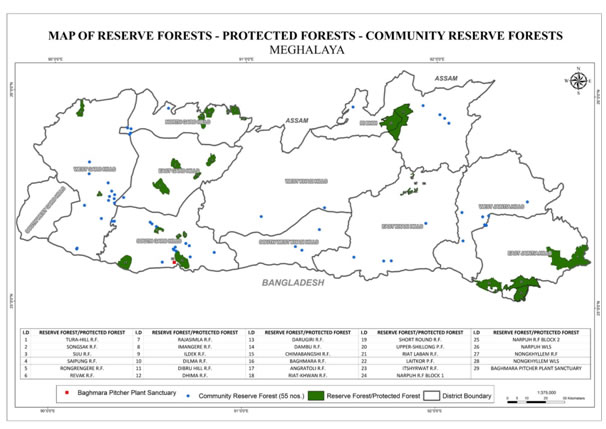
Baghmara Pitcher Plant Sanctuary
An extremely specialized, highly critical botanical sanctuary created exclusively for the in-situ protection of the Nepenthes khasiana (carnivorous Pitcher Plant), locally named Me'mang-Koksi ("Ghost Basket"). It is sacredly protected by local communities.
Key Species Protected
Wildlife (Protection) Act, 1972
Both National Parks and Wildlife Sanctuaries represent designated protected areas under the provisions of the Wild Life (Protection) Act, 1972, acting under strict legal status to forbid degradation of natural flora and fauna.
The boundaries of National Parks are strictly notified, permitting zero resource harvesting or private claims, guaranteeing absolute ecological sanctuary.
Criteria
National Park
Sanctuary
Human Activities
Strictly Prohibited
Highly Restricted
Focus Focus
Entire Ecosystem
Target Wildlife Species
Upgradable
Maximum Legal Cap
Can become National Park