

CAMPA
Introduction
The Supreme Court of India ordered the creation of CAMPA in 2001 to manage the Compensatory Afforestation Fund. Under the Forest (Conservation) Act, 1980, compensatory afforestation makes up for forest land diverted to non-forestry use, replacing land with land and trees with trees.
The CAF Act, 2016 and Rules, 2018 now govern all CAMPA work. Each State prepares an Annual Plan of Operation, which its Executive and Steering Committees scrutinise and the National CAMPA Authority, MoEF&CC, finally sanctions. The funds go to forest and tree cover, wildlife conservation and transparent fund management.
Objectives
- Conservation, protection, regeneration and management of existing natural forests
- Conservation, protection and management of wildlife and its habitat within and outside protected areas, including the consolidation of the protected areas
- Compensatory afforestation
- Environmental services
Laws Governing CAMPA
The Forest (Conservation) Act
Enacted by the Central Government to regulate the use of forest land for non-forestry purposes with the prior approval of the Central Government. The rules under the Act stipulate that diversion of forest land requires equivalent non-forest land, payment for Compensatory Afforestation, the Net Present Value of the forest land being diverted, and other charges.
Compensatory Afforestation Fund (CAF) Act
Notified by the Ministry of Law and Justice (No. 38 of 2016) on 3rd August 2016 to reframe and augment the implementation of stipulated conditions of forest land transfer proposals. It creates a non-lapsable and interest-bearing Compensatory Afforestation Fund at the National and State level for the management and utilisation of monies collected under the Forest (Conservation) Act, 1980, and provides for a National Authority and a State Authority in each State and Union Territory. The Act is effective from 30th September 2018.
Compensatory Afforestation Fund (CAF) Rules
Notified by the Ministry of Environment and Forests, Government of India, New Delhi on 10th August 2018 for the implementation of the CAF Act, 2016.
Constitution of Meghalaya State CAMPA
The Meghalaya State Compensatory Afforestation Fund Management and Planning Authority has notified a special fund referred to as the State Compensatory Afforestation Fund (SCAF) vide Government letter No. FOR.113/98/Pt/Vol-II/3 dated 18.02.2019. This notification was partially modified vide Government letter No. FOR.40/2016/165 dated 26th May 2020.
The State Government has also notified the Governing Body, the Steering Committee and the Executive Committee of the Meghalaya State Authority of the State Compensatory Afforestation Fund Management and Planning Authority.
The Three Committees
Constituted under Section 10(5) of the CAF Act, 2016, vide Notification No. FOR.113/98/Pt/Vol-II/395 dated 8th April 2022, under the Chairmanship of the Chief Minister, Government of Meghalaya, with 13 members.
Powers and functions
- Lay down the broad policy framework for the functioning of the State Authority within the overall framework notified by the Central Government on the recommendations of the National Authority
- Review the working of the State Authority from time to time
Constituted under Section 11(2) of the CAF Act, 2016, vide Notification No. FOR.113/98/Pt/Vol-II/393 dated 8th April 2022, under the Chairmanship of the Chief Secretary, Government of Meghalaya, with 16 members.
Powers and functions
- Scrutinise and approve the annual plan of operations prepared by the executive committee and send it to the National Authority
- Monitor the utilisation of funds released from the State Fund
- Review reports on decisions taken by the executive committee including investment decisions
- Approve proposals for creation of posts, subject to prior concurrence of the State Government
- Approve the annual report and send it to the State Government to be laid before each House of the State Legislature
- Ensure inter-departmental coordination
Constituted under Section 11(3) of the CAF Act, 2016, vide Notification No. FOR.113/98/Pt/Vol-II/394 dated 8th April 2022, under the Chairmanship of the Principal Chief Conservator of Forests (HoFF), with 18 members.
Powers and functions
- Formulate and submit the annual plan of operations to the steering committee
- Undertake qualitative and quantitative supervision, monitoring and evaluation of works implemented from the State Fund
- Invest surplus amounts
- Maintain books of account and other records
- Submit reports to the steering committee
- Prepare the annual report
- Deploy staff on contract or deputation
- Formulate proposals for creation of posts
- Delegate financial and administrative powers
- Oversee day-to-day working of the State Authority
- Maintain and update the public information system and place all transactions in the public domain
- Undertake any other work assigned by the governing body, steering committee or State Government
Utilisation of the Money
- 1Money received for Compensatory Afforestation, additional compensatory afforestation, penal compensatory afforestation, Catchment Area Treatment Plan and any other site-specific scheme is used as per the site-specific schemes submitted by the State along with the approved proposals for diversion of forest land under the Forest (Conservation) Act, 1980.
- 2After receipt of the money, State CAMPA shall accomplish the afforestation for which money is deposited in the Compensatory Afforestation Fund within one year or two growing seasons after project completion, as may be appropriate.
- 3Money received on account of Net Present Value shall be used for natural assisted regeneration, forest management, protection, infrastructure development, wildlife protection and management, and other allied activities.
- 4State CAMPA shall release monies to the Implementing Agencies as per the Annual Plan of Operation finalised.
Monitoring Mechanism
Monitoring of works carried out under the CAMPA fund is essential for ensuring transparency, effectiveness and accountability towards implementation of the CAF Act, 2016 and CAF Rules, 2018. As per Rule 5(3)(h) of the CAF Rules, 2018, independent concurrent monitoring and evaluation and third-party monitoring of various works undertaken from the State Fund are to be carried out.
The Meghalaya Forest Department has assigned the Rain Forest Research Institute, Jorhat as the third party for undertaking Monitoring & Evaluation of Compensatory Afforestation and other related CAMPA activities undertaken by the respective implementing agencies in the State.
The office of the Principal Chief Conservator of Forests & HoFF, Meghalaya has also constituted standard formats and procedures for undertaking internal Monitoring and Evaluation of plantations and works under CAMPA, with the Additional Principal Chief Conservator of Forests (CC, R&T) as the Head of Internal Monitoring and Evaluation for activities under State CAMPA.
Organizational Structure
The Meghalaya State CAMPA functions through a CAMPA section or cell in the office of the Principal Chief Conservator of Forests & HoFF, Meghalaya, headed by a Nodal Officer (FC & CAMPA) / CEO CAMPA, who is assisted by a Deputy Conservator of Forests (FC Act) and supported by 5 CAMPA staff and 4 assistants.
Functions of the State CAMPA Cell
- 1Formulation of the Annual Plan of Operations.
- 2Convening Executive Committee and Steering Committee meetings of the State for approval of the APO, and appraising the members of the progress of implementation and the yearly status of funds.
- 3Communicating the State-approved APO to the National Authority CAMPA for approval by its Executive Committee.
- 4Preparation of schemes and regulation of the release of funds to all Implementing Agencies as per the approved APO.
- 5Preparation and maintenance of progress reports, both physical and financial, of works implemented under each APO.
- 6Monitoring and undertaking field inspections and internal Monitoring & Evaluation.
- 7Overseeing Monitoring & Evaluation by a third party for all CAMPA activities.
- 8Convening the Governing Body meeting to appraise the body of the progress of the scheme in the State.
- 9Issuing guidelines from time to time on procedures and techniques adopted for implementation of the scheme.
- 10Monitoring and reviewing the audit of accounts of the scheme.
- 11Maintaining proper accounts and the cash balances in the State CAMPA account.
- 12Monitoring both release and expenditure of funds.
- 13Documentation and annual report preparation.
List of All Implementing Agencies
The agencies that implement CAMPA works across the State, by wing and jurisdiction.
| Sl. No. | Circle | Division | District |
|---|---|---|---|
| 1 | Territorial Wing | T Williamnagar | East & North Garo Hills |
| 1 | Territorial Wing | T Shillong | East Khasi Hills & Ri-Bhoi |
| 1 | Territorial Wing | T Tura | West & South West Garo Hills |
| 1 | Territorial Wing | T Baghmara | South Garo Hills |
| 1 | Territorial Wing | T Jowai | East & West Jaintia Hills |
| 1 | Territorial Wing | T Nongstoin | West & South West Khasi Hills |
| 2 | Wildlife Wing | WL Shillong | East Khasi Hills, Ri-Bhoi, South & South West Khasi Hills |
| 2 | Wildlife Wing | WL Tura | East & West Garo Hills |
| 2 | Wildlife Wing | WL Jowai | East & West Jaintia Hills |
| 2 | Wildlife Wing | Balpakram National Park | South Garo Hills |
| 3 | Social Forestry Wing | SF Shillong | East Khasi Hills |
| 3 | Social Forestry Wing | SF Jowai | East & West Jaintia Hills |
| 3 | Social Forestry Wing | SF Nongpoh | Ri-Bhoi |
| 3 | Social Forestry Wing | SF Williamnagar | East & North Garo Hills |
| 3 | Social Forestry Wing | SF Tura | West & South West Garo Hills |
| 3 | Social Forestry Wing | SF Baghmara | South Garo Hills |
| 3 | Social Forestry Wing | SF Nongstoin | West & South West Khasi Hills |
| 4 | CC, R & T | Silviculture | For all Districts |
| 4 | CC, R & T | Working Plan | For all Districts |
| 4 | CC, R & T | Training | For all Districts |
| 4 | CC, R & T | Forest Utilisation | For all Districts |
| 4 | CC, R & T | Forest Resource Survey | For all Districts |
| 4 | CC, R & T | Khasi Hills Autonomous District Council | East Khasi Hills, Ri-Bhoi, West & South West Khasi Hills |
| 4 | CC, R & T | Garo Hills Autonomous District Council | West, South West, North Garo Hills, East Garo Hills & South Garo Hills |
| 4 | CC, R & T | Jaintia Hills Autonomous District Council | East & West Jaintia Hills |
The Annual Plan of Operation (APO)
The Annual Plan of Operation is prepared by the Meghalaya Compensatory Afforestation Fund Management and Planning Authority as per Rule 39 of the CAF Rules, 2018.
- Each year the Implementing Agencies — including Forest Divisions, offices of CFOs and the Autonomous District Councils — prepare the Annual Plan of Operation for their respective areas as per the CAF Rules, 2018 and submit it to their respective wing heads. The controlling officers of each wing head examine the APOs and, after their final approval, submit them to the State CAMPA Office.
- The State CAMPA Office compiles the APOs submitted by the Implementing Agencies and presents them before the Executive Committee, chaired by the Principal Chief Conservator of Forests & HoFF, Meghalaya, for final formulation.
- The Executive Committee of State CAMPA, as per Section 19(1)(i) of the CAF Act, 2016, formulates and submits the Annual Plan of Operation to the Steering Committee of State CAMPA, chaired by the Chief Secretary, Meghalaya, for its concurrence.
- The Steering Committee, as per Section 18(1)(i) of the CAF Act, 2016, scrutinises and approves the Annual Plan of Operation prepared by the Executive Committee. Once approved, it is sent to the office of the CEO, National CAMPA, New Delhi for placing before the Executive Committee of the National Authority.
- The Executive Committee of the National Authority, as per Section 15(1)(i) of the CAF Act, 2016, approves the Annual Plan of Operation submitted by State CAMPA with such amendments or conditions as it deems fit and proper.
Key Achievements
Afforestation and nursery works created under the CAMPA fund.
Compensatory Afforestation
Plantation Created: 444.08 ha
Nursery Created: 2207 beds
Biodiversity Conservation Plan
Plantation Created: 100 ha
Nursery Created: 261 beds
NPV
Plantation Created: 1168.37 ha
Nursery Created: 4404 beds
Catchment Area Treatment
Plantation Created: 362.32 ha
Nursery Created: 640.5 beds
Infrastructure & Protection
Firelines
516.79 kms
Fencing
15.4 kms
Boundary Pillars
5071 nos.
Solar Street Lights
225 nos.
Inspection / Patrolling Paths
Patrolling paths: 978 kms
Footpath: 7.1 kms
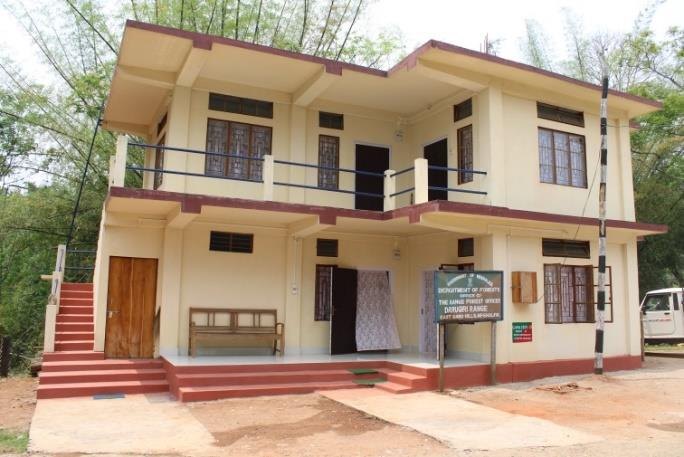
Office / Quarters
Constructed: 52 nos.
Maintained: 176 nos.
Checkdams
82 nos.
Water Harvesting Structures
89 nos.
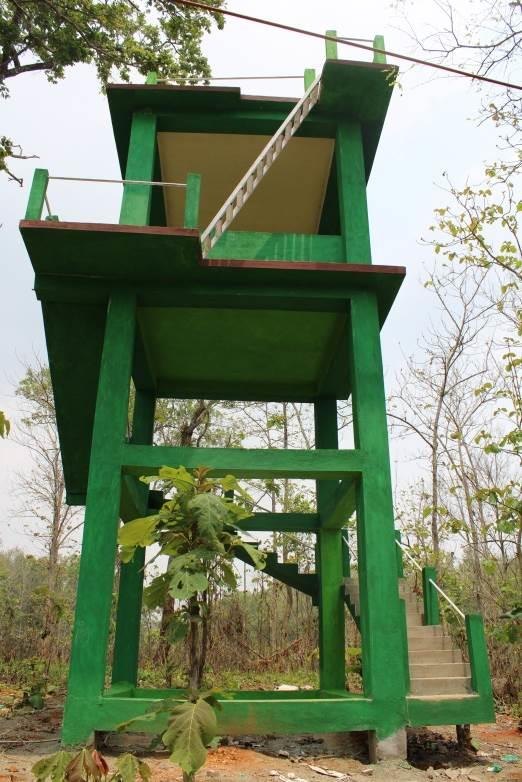
Watch Towers
61 nos.
Community & Capacity Building
Gallery
Plantations, nurseries and infrastructure created under the CAMPA fund across Meghalaya.